Part 4
When plans break
Deviations, emergency preparedness and the on-call rota. What has to hold when something goes wrong.
In this part
10. Deviations and changes: communicating when the plan breaks
Plans break. Weather, illness, postponed operations and changed client needs are the norm, not the exception. What separates good coordinators from the rest is not an absence of changes but how changes are communicated.
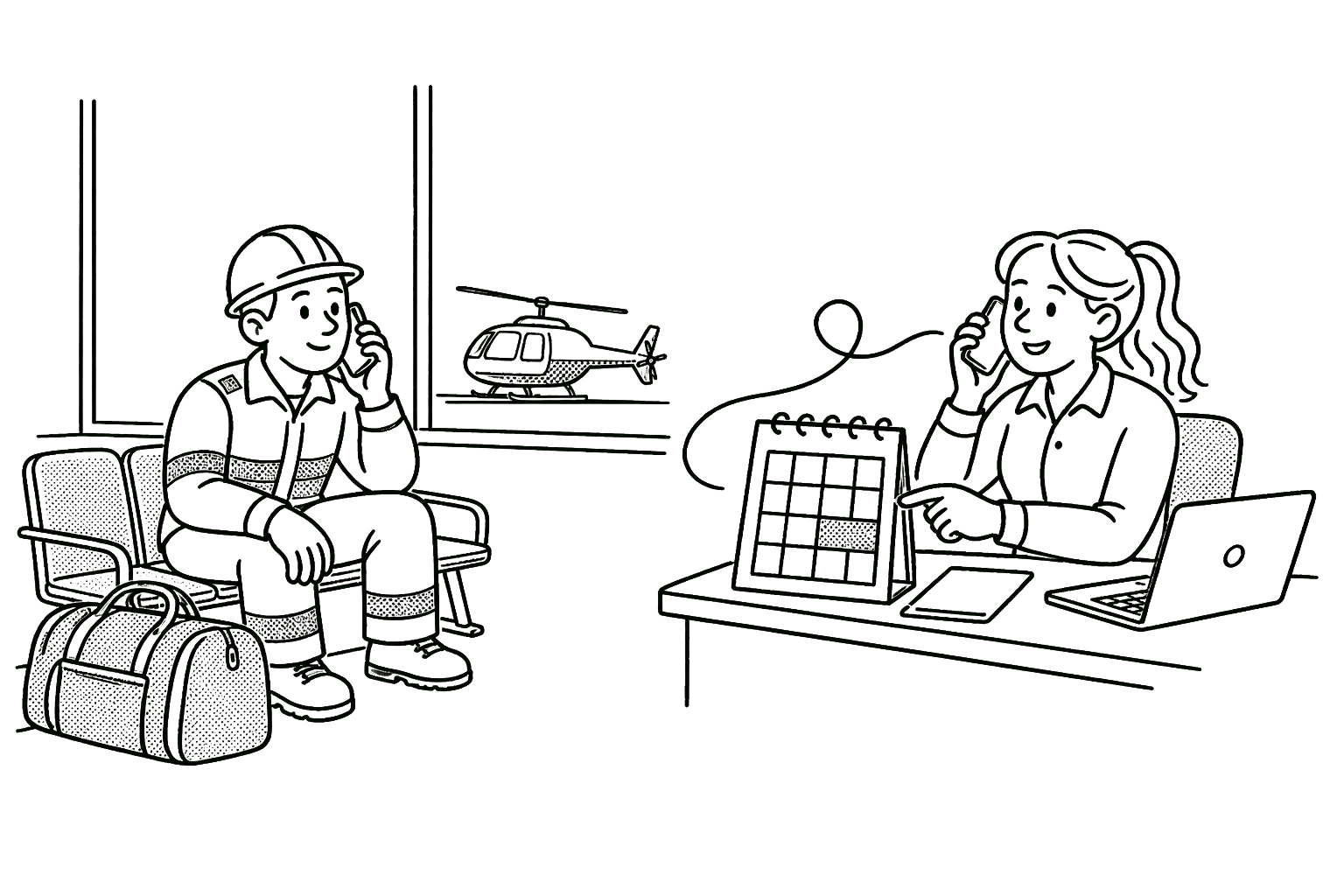
A good change notice always answers four questions, in this order:
- What has changed? Concrete and unambiguous: dates, times, installation.
- Why? One sentence is enough. A reason builds trust; silence builds rumours.
- What does it mean for you? Consequences for travel, compensation, the next period of time off.
- What do you have to do? Confirm, report somewhere else, wait for a further message by a stated time.
Other rules for handling deviations:
- Give notice early, even with incomplete information. "The assignment is probably postponed, final confirmation Thursday" beats waiting for full clarity.
- Phone for big changes, confirm in writing afterwards. Cancelling a trip someone has planned their life around deserves a call, not an email.
- Always have a fallback for critical positions. A maintained list of qualified and available reserve personnel, with agreed terms for short notice, turns a sickness absence into routine rather than a crisis.
- Standby has to be agreed, not assumed. Where personnel are expected to be available at short notice, that should be regulated and compensated in line with the agreement (see 4.2).
11. Emergency preparedness: when the coordinator's data becomes critical
Day to day, the POB overview and the personnel data are an administrative tool. The day the alarm sounds on an installation, they are the basis of the emergency response: who is on board, who is missing, and who to notify. The quality of that data is decided long before the incident, by the coordinator's daily discipline.
11.1 POB accuracy is an emergency function, not administration
- The POB should be correct at all times, not by the end of the day. Every mobilisation, demobilisation, extension and internal transfer should be reflected immediately, not "during the day". At a muster, the gap between the recorded and the actual POB is the definition of chaos.
- Personnel movements should carry a complete audit trail: who, where, when, decided by whom. In an incident or an investigation, this is the documentation that shows what the company knew and did.
11.2 Next-of-kin information: verify at every mobilisation
- Next-of-kin information (closest relative with telephone number and relationship) should be recorded for all personnel and readily available to those who need it in an emergency, around the clock.
- Verify at every mobilisation. Ask the employee to confirm that their next-of-kin details are correct as part of the mobilisation confirmation. Lives change: separations, house moves, new phone numbers. Out-of-date next-of-kin information is always discovered at the worst possible moment.
- Next-of-kin data concerns someone who is not employed by you and who never chose to have a relationship with the employer. Store it with access control, use it only for its purpose, and do not pass it on.
11.3 The coordinator's role in the emergency response plan
The company's emergency response plan should define the coordinator's role explicitly, and the coordinator should know it before anything happens:
- Know how your preparedness connects to the client's. In an incident on an installation, the operator's emergency organisation leads the response. The employer still owns the care of, and the contact with, its own employees and their families. Agree the interface with each client: who notifies whom, in what order, with what information.
- Families must never learn of it from the media or social media first. In an incident that becomes public, early and coordinated contact with next of kin is decisive, even when the message is only "we confirm an incident is under way, your [relation] is accounted for" or "we do not have the full picture yet, we will call again by [time]".
- One voice, confirmed information only. The coordinator should never speculate to next of kin or to colleagues. Pass on what is confirmed, be honest about what is unknown, and give a specific time for the next update.
- Notification of a death or serious injury follows its own procedures involving the police and, where relevant, a chaplain or crisis team, and should never happen by phone from a coordinator alone. Know the procedure and your part in it.
11.4 Medical evacuation and early repatriation
In case of illness or injury on board, the installation and the operator handle the medical side and the evacuation itself. The coordinator owns the shore side:
- Receive the notification and inform next of kin in line with the agreed routine.
- Arrange onward transport, collection and, where needed, a hotel for the evacuated person.
- Plan replacement personnel if the operation requires it, in parallel rather than afterwards.
- Follow up the evacuated person afterwards: sickness absence follow-up, the insurance case, return to work.
11.5 Practise
Take part in clients' emergency exercises where you can, and run your own notification drills: can the duty coordinator produce a correct POB and next-of-kin list for a given installation in under five minutes, on a Sunday evening? If the answer is no, the exercise is the thing that should reveal it, not the incident.
12. On-call rota and continuity: the function must never be one person
Offshore crewing does not follow office hours. Helicopters leave early, operations change overnight, and incidents happen when they happen. At the same time, coordination is a discipline where a great deal of knowledge easily ends up in the head and the inbox of one person. Both have to be solved structurally:
- Defined availability outside office hours. On mobilisation and demobilisation days a known duty number should be staffed from before the first departure until the last person is confirmed as arrived. For companies with continuous operations: a formal on-call rota covering evenings, weekends and public holidays, with agreed compensation.
- A deputy, always. Every coordinator should have a named deputy who can take over at hours' notice. That requires the deputy to have access to the same systems and to know the same routines, not merely to be a name in a plan.
- Routines in a system, not in an inbox. All active mobilisations, pending confirmations, open changes and agreements should be visible in a shared system so that a deputy can take over without archaeology in someone else's email. The test is simple: could a competent colleague take over your portfolio tomorrow morning without calling you? If not, critical information is living in the wrong place.
- A structured handover at holidays and absences: a walkthrough of active and upcoming assignments, open deviations, things awaiting a reply, and known risks for the coming weeks. In writing, with a short verbal walkthrough.
- An escalation matrix. The duty coordinator should know who to contact for decisions beyond their own mandate (cancelling a mobilisation, approving extraordinary costs, activating emergency response), with names and numbers rather than job titles.